
–peer-to-peer
-ad hoc
-mobile
-hybrid
-mesh
-network
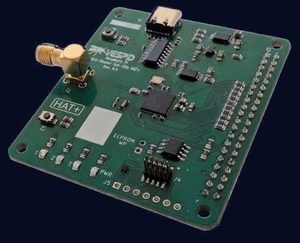
Orbweaver is a fully open source radio that allows you to set-up your own wireless networks in the Sub-GHz license-free ISM band. Orbweaver enables secure communication between Raspberry Pis, desktops, laptops, and Android devices without reliance on existing communication infrastructure. We provide an easy to use configuration utility as well as example code written in Python in our GitHub repository.
Buy it Online:
Coming soon
GitHub:
https://github.com/vespid-tech/orbweaver
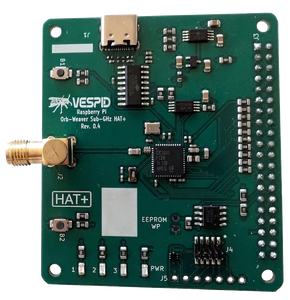
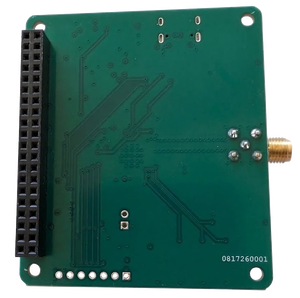
- fully open source hardware, firmware, and software
conforms to Raspberry Pi HAT+ specification - designed for use with Raspberry Pi 5
- optional power via USB 3.0
- optional communication via USB-C with standard Windows and Android serial port drivers
- SMA antenna connector (antenna not included)
- 2×5 1.27 mm header for use with XDS200 Debug Probe
- 7 0.1 inch plated through holes for debugging with TI CC1310 eval kit (header pins not installed)
- fits HighPi Pro Case 5S for Raspberry Pi 5 with Universal Opening
For questions, concerns, or inquires, use the Discussion forum: Discussion Forum
Report bugs in the issue tracker: Issue Tracker
Orbweaver is a Raspberry Pi 5 HAT+.
Orbweaver’s USB C receptacle should be recognized as a serial device on any platform that uses uses standard USB to serial drivers (e.g. Windows, Linux, and Android). We have tested Orbweaver with Windows 11, Android 17, and Raspberry Pi OS.
No. The device ships with a bootloader only. You can find pre-built Orbweaver firmware binaries on the Orbweaver GitHub respository: Orbweaver releases.
Instructions on how to load the binary can be found in the Orbweaver Quick-Start Guide: Quick Start Guide
Yes. You will need an antenna.
If you want to use the Orbwaever via USB, you will need a USB cable.
If you want to debug firmware on the device, you will need to purchase a debug probe.
Wireless communication is accomplished via the sub-GHz ISM band and the Orbweaver protocol. It does not depend on any existing networks or infrastructure.
It depends on radio configuration, antenna selection, device placement, and the operating environment. 1-2 kilometers line-of-sight is a best guess for bitrates around 50 kbps in many standard situations while using a quality omni-directional antenna:
For more, see the Orbweaver User Manual: User Manual
Yes. The Orbweaver is designed to enable communication between Raspberry Pis, desktops, laptops, and mobile devices.
No.
Orbweaver supports higher bitrates than LoRa making applications such as audio possible.
Orbweaver is much more customizable at runtime which makes it easier to tailor to any particular application or use case. Bitrate, frequency hopping, encryption, and operating frequency are all configurable at runtime.
Orbweaver is fully open source and utilizes standard modulation methods, so the firmware can theoretically be ported to radio SoCs from different manufacturers. LoRa modulation is proprietary, and the transceivers are only available from Semtech.
Semtech LoRa modules tend to be more expensive than CC1310s and other Sub-GHz devices that utilize the same modulation as Orbweaver.
We like arthropods.
Find the Quick Start Guide, Programming Guide, and User Manual in the documentation folder of the Orbweaver GitHub: documentation
Orbweaver is distributed under the following open source licenses:
Hardware license: CERN Open Hardware Licence Version 2 – Strongly Reciprocal (CERN-OHL-S-2.0)
Software and firmware license: GNU General Public License v3.0 (GPL-3.0-only)
Documentation: Creative Commons Attribution-NonCommercial 4.0 International (CC BY-NC 4.0)
For the full licenses see our GitHub: Orbweaver GitHub
“Vespid,” “Orbweaver,” and associated logos are trademarks of Vespid, LLC.
Orbweaver is provided “as is,” without warranty of any kind, express or implied. In no event shall Orbweaver developers or contributors be liable for any claim, damages, or other liability arising from its use. Orbweaver is intended for evaluation and development use only. It is not supplied as a finished product and is not certified for use in any product made for sale to the general public. The purchaser is responsible for ensuring that the final configuration (including but not limited to firmware configuration, transmission power, antenna selection, transmission frequency, etc.), complies with applicable regulatory requirements.